How to check a Latin American contractor against the OFAC sanctions list, step by step
Search the contractor's full legal name, and their company's, on OFAC's free Sanctions List Search before you sign and before each payment run. Search at the default score of 100, then at about 85 to catch misspellings. A hit is a lead, not a verdict: compare the type, program, ID numbers and addresses on the full record, and keep the saved result for at least 10 years.

At a glance
- Who runs it
- OFAC, the US Treasury's Office of Foreign Assets Control[1]
- Cost and sign-in
- Free and public, with no account[1]
- What it searches
- The SDN List and OFAC's other sanctions lists in one lookup[1]
- SDN List size
- 19,484 entries, 1,228 of them with an address in Mexico (list of October 28, 2026)[2]
- Matching
- Approximate, with a minimum name score from 50 to 100[1]
- Records to keep
- At least 10 years after the transaction[3]
Overview
US persons generally may not deal with the people and companies on OFAC’s SDN List: their property is blocked, and a payment to them has to be blocked or rejected.[7] Checking a contractor takes a few minutes on OFAC’s free Sanctions List Search, which covers the SDN List and OFAC’s other sanctions lists in one lookup.[1]
Latin America is not a side case. Of the 19,484 entries on the SDN List last updated on October 28, 2026, 2,358 list an address in Latin America, and 1,228 list one in Mexico, the third-highest count of any country after Russia and Iran.[2] Screening sits next to the rest of the onboarding paperwork: a W-8BEN from an individual contractor, a W-8BEN-E from a company and, in Mexico, an RFC check. This manual runs one search for a company that is on the list, Venezuela’s state oil company, and one for a name that is not.
Open OFAC's Sanctions List Search
Go to sanctionssearch.ofac.treas.gov. It is free, and there is no account or sign-in. One lookup covers the SDN List and the other lists OFAC administers, such as the Foreign Sanctions Evaders List and the Sectoral Sanctions Identifications List.[1] The tool uses approximate string matching, so it also returns names close to what you type, and a slider sets how close a result must be. OFAC does not recommend any particular setting, and it says the tool is not a substitute for due diligence.[1]
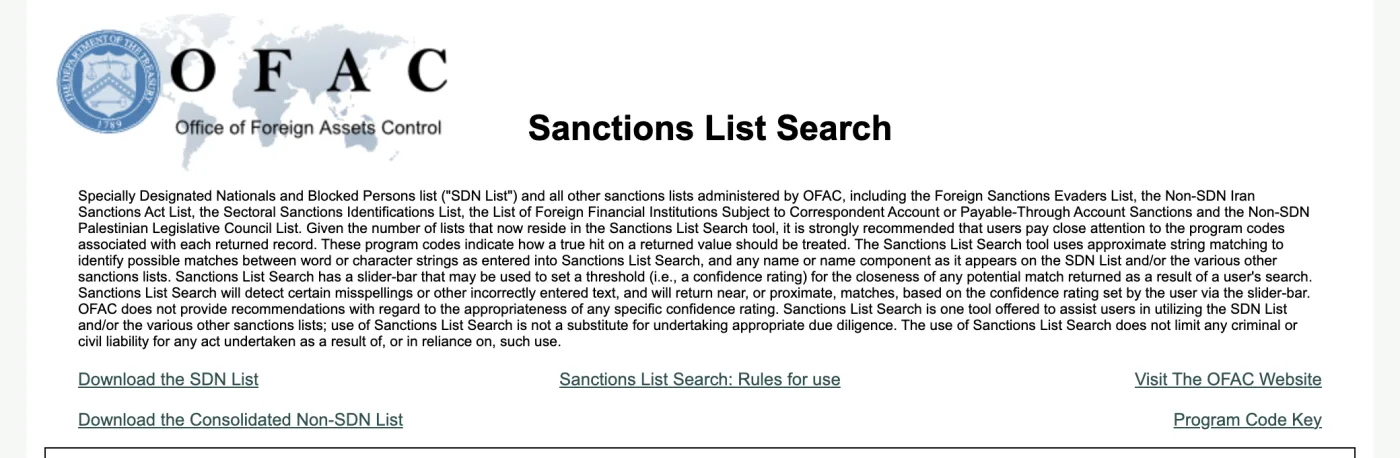
OFAC Sanctions List Search, captured by Nearshorers on November 2, 2026. Source: sanctionssearch.ofac.treas.gov.
- Sanctions List Search: OFAC's free public tool.
- One lookup covers the SDN List and OFAC's other lists.
- Approximate matching, with a slider for how close a match must be.
- Download the SDN List: the same data as files.
- Program Code Key: what each program code means.
Type the legal name and search at a score of 100
Type the full legal name as it appears on the contractor’s ID. Latin American names often carry two surnames, so search the full name first and then the given name with each surname. If the contractor invoices through a company, search its legal name and its trade name as well. Leave Type, Program, Country and List on All: narrowing them can hide a record you did not expect. The Minimum Name Score starts at 100, the strictest setting; keep it there for the first search and press Search.[1] The example searches PETROLEOS DE VENEZUELA, a company on the SDN List.
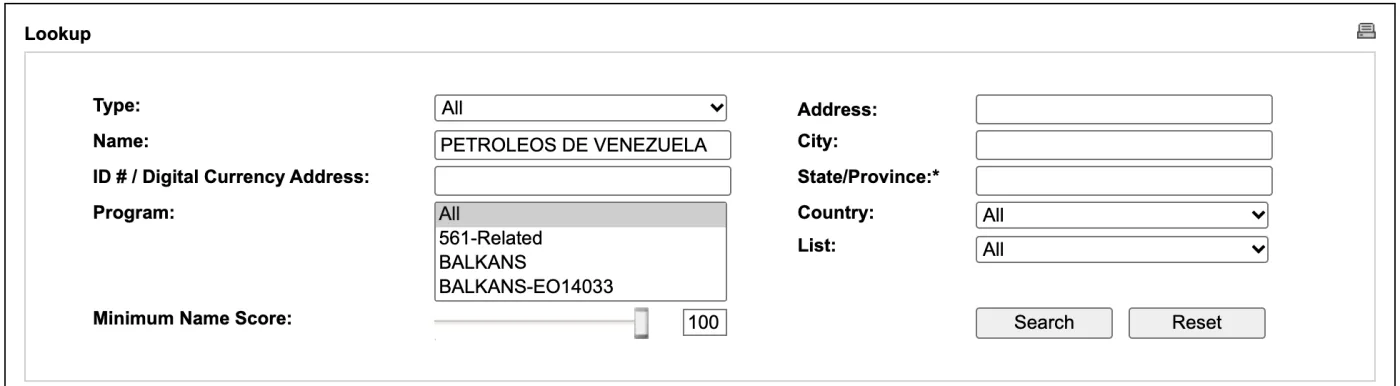
Lookup form, searched by Nearshorers on November 2, 2026. Source: sanctionssearch.ofac.treas.gov.
- Name: the full legal name, then the given name with each surname.
- Program: leave on All.
- Country and List: leave on All.
- Minimum Name Score: 100 for the first search.
- Search runs the lookup.
Read the results table
Each row is a record on a list, not a verdict. Name is the name or alias that matched, Type says whether the record is an individual, an entity, a vessel or an aircraft, Program(s) gives the sanctions program codes, List says which OFAC list holds the record, and Score is how closely the name matched your search.[1] Here three rows score 100: the same company under its name and two of its aliases, on the SDN List under VENEZUELA-EO13850, the code for Executive Order 13850.[8]
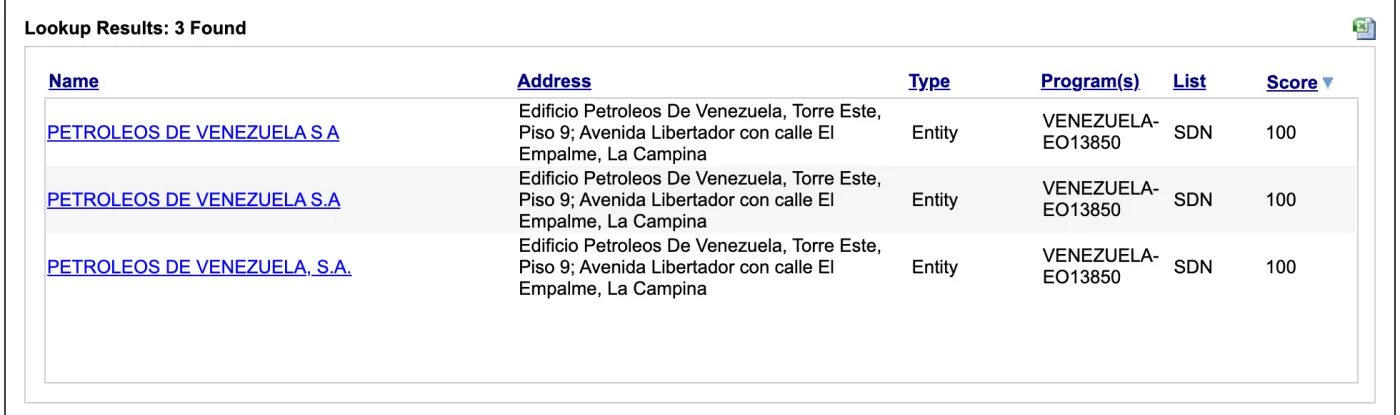
Results for PETROLEOS DE VENEZUELA at a minimum score of 100, searched by Nearshorers on November 2, 2026. Source: sanctionssearch.ofac.treas.gov.
- Lookup Results: how many rows matched.
- Name: the name or alias that matched.
- Type: individual, entity, vessel or aircraft.
- Program(s): the sanctions program codes.
- List: which OFAC list holds the record.
- Score: how closely the name matched.
Open the record and compare every identifier
Click the name to open the full record: type, list and program, identification numbers, every alias and every address.[1] OFAC’s guidance is to compare the whole entry, including aliases, identifiers and addresses, with the information you hold. If very few details match, you may reasonably treat the hit as invalid; if several match, follow your compliance procedure and check whether a general or specific license or an exemption applies.[7] OFAC does not confirm potential matches or false positives for you. For a contractor, compare the record with the ID and tax number you collected at onboarding. This record lists a Venezuelan RIF tax number, the alias PDVSA and two addresses in Caracas.[1]
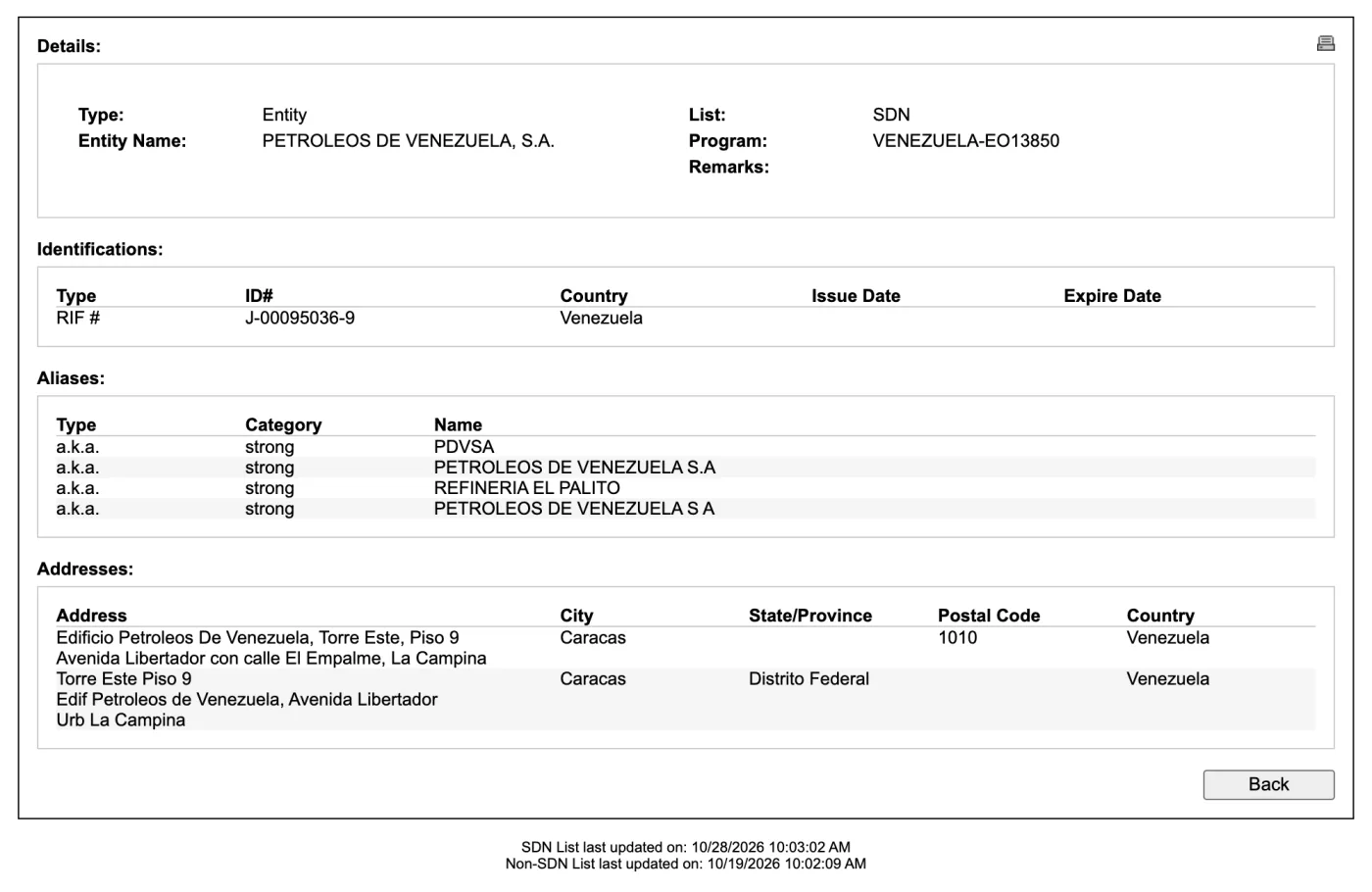
The full record behind the first result, captured by Nearshorers on November 2, 2026. Source: sanctionssearch.ofac.treas.gov.
- Entity Name: the name on the list.
- List SDN and program VENEZUELA-EO13850.
- Identifications: the tax number to compare.
- Aliases: every other name on the record.
- Addresses: city and country to compare.
Lower the score to catch misspellings
Names get misspelled in contracts, invoices and bank details, so search again with a lower minimum score. With the name typed wrongly as PETROLEOS DE VENESUELA and the score at 85, the tool still found the three rows, now scoring 98, and added four unrelated names scoring 85 to 87.[1] That is what a false positive looks like: a similar name with nothing else in common. The slider runs from 50 to 100, and OFAC does not recommend a setting.[1]
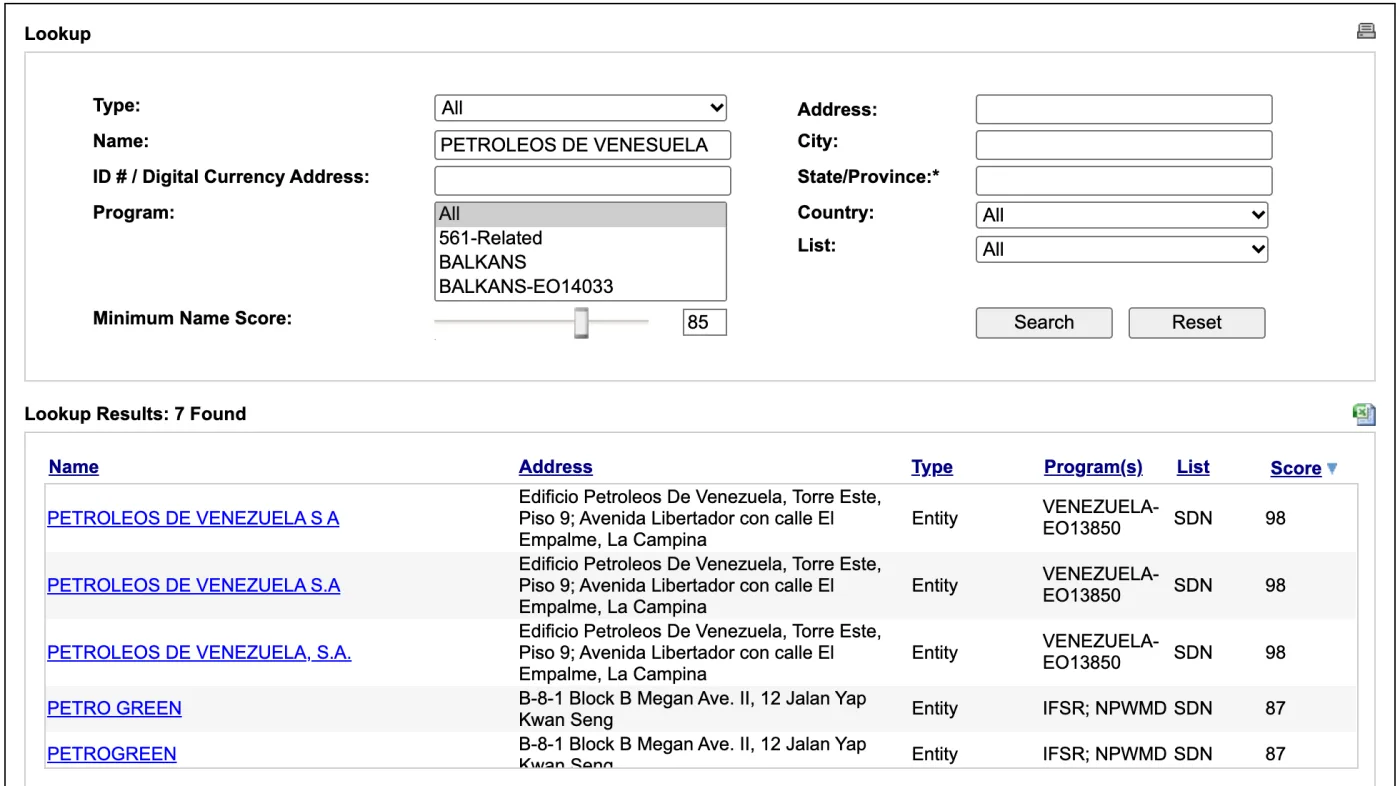
The same company, misspelled, at a minimum score of 85, searched by Nearshorers on November 2, 2026. Source: sanctionssearch.ofac.treas.gov.
- The name, misspelled on purpose.
- Minimum Name Score lowered to 85.
- Seven rows instead of three.
- The real record still scores 98.
- An unrelated company scores 87: a false positive.
Save the result and run it again before you pay
When nothing matches, the results table says so. Print the page or save it as a PDF with the printer icon, or export the results to Excel, and file it with the contract: the name searched, the score used, the date, and the list dates shown at the bottom of the page.[1] OFAC’s recordkeeping rule requires records of transactions subject to its regulations to be kept for at least 10 years, so keep the screening evidence at least as long.[3] The SDN List in this search was last updated on October 28, 2026; screen again before each payment run, not only at onboarding.[1]
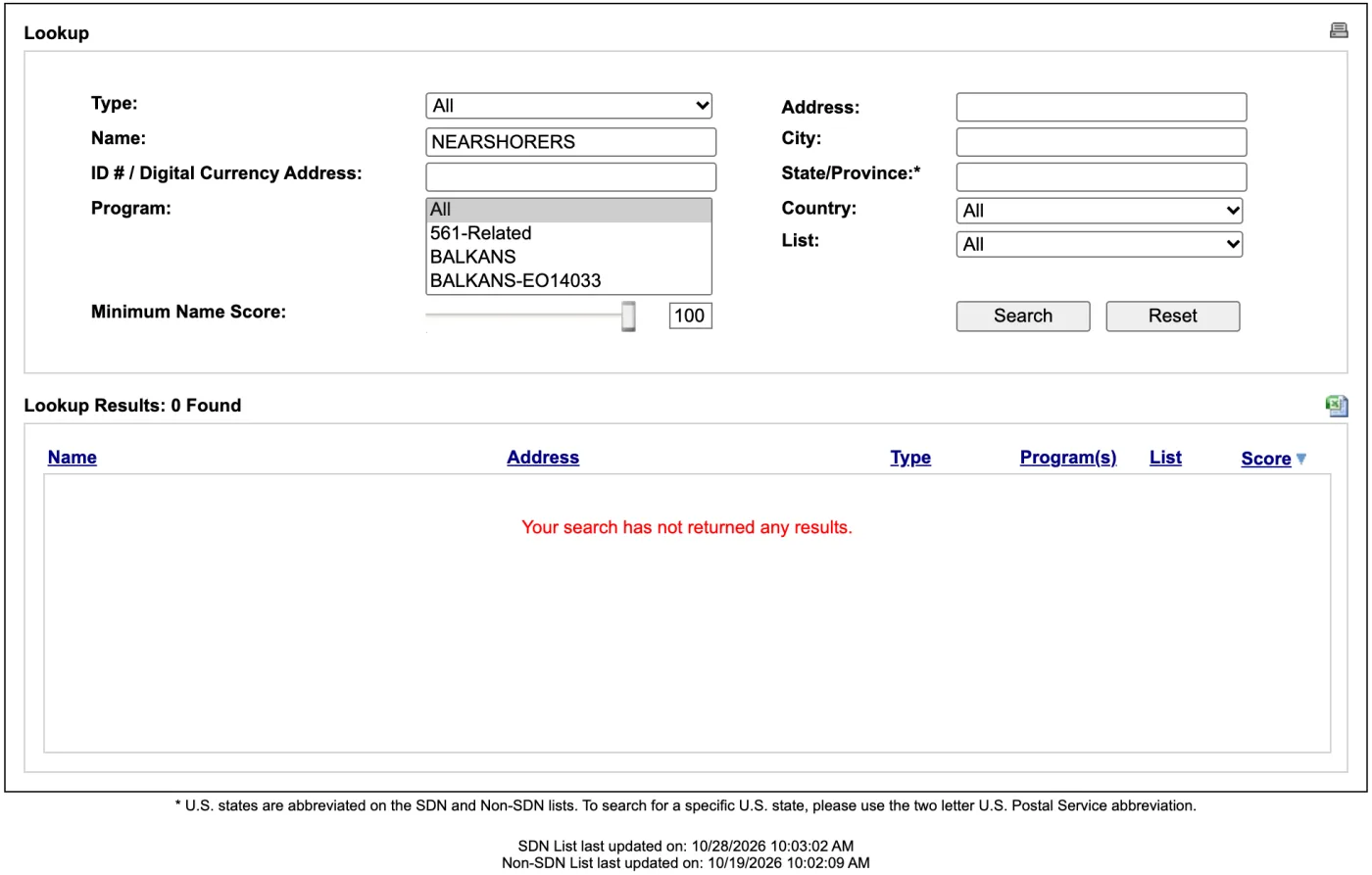
A search with no match, run by Nearshorers on November 2, 2026. Source: sanctionssearch.ofac.treas.gov.
- The name you searched.
- Lookup Results: 0 Found.
- The tool's no-match message.
- Print the page or save it as a PDF.
- Export the results to Excel.
- When the SDN and non-SDN lists were last updated.
Do US companies have to screen contractors in Latin America?
Civil liability for sanctions violations does not depend on knowing. OFAC can penalize a person subject to US jurisdiction even if it did not know or have reason to know that the transaction was prohibited.[9] Screening is how companies avoid that. OFAC’s compliance framework says a sanctions program should rest on at least five components: management commitment, risk assessment, internal controls, testing and auditing, and training.[10] It notes that many organizations screen their customers, supply chain, counterparties and transactions, and it lists screening tools that missed list updates or alternative spellings among the root causes of past violations.[10]
For a company hiring in Latin America, three moments cover most of the risk:
- At shortlist: the person, and their company if they invoice through one.
- At signature: the legal name on the contract and the holder of the bank account you will pay.
- Before each payment run: the lists change, so a clean result from onboarding goes stale.
Which sanctions programs show up in Latin America?
Each result carries one or more program codes, and OFAC asks users to pay close attention to them because they indicate how a true hit should be treated.[1] The Program Code Key gives the legal basis of each code. These are the ones a hiring team in Latin America meets most often:[8]
| Code | Legal basis | Area |
|---|---|---|
| SDNTK | Foreign Narcotics Kingpin Sanctions Regulations, 31 CFR part 598 | Narcotics |
| ILLICIT-DRUGS-EO14059 | Executive Order 14059 | Narcotics |
| TCO | Transnational Criminal Organizations Sanctions Regulations, 31 CFR part 590; Executive Order 13581 | Criminal organizations |
| SDGT | Global Terrorism Sanctions Regulations, 31 CFR part 594 | Terrorism |
| FTO | Foreign Terrorist Organizations Sanctions Regulations, 31 CFR part 597 | Terrorism |
| CUBA | Cuban Assets Control Regulations, 31 CFR part 515 | Cuba |
| CUBA-EO14404 | Executive Order 14404 | Cuba |
| VENEZUELA, VENEZUELA-EO13850, VENEZUELA-EO13884 | Executive Orders 13692, 13850 and 13884 | Venezuela |
| NICARAGUA | Executive Order 13851 | Nicaragua |
In February 2025 the State Department designated eight groups as Foreign Terrorist Organizations, among them Cartel de Sinaloa, Cartel de Jalisco Nueva Generacion, Cartel del Golfo, Cartel del Noreste and Tren de Aragua.[11] On the October 28, 2026 list, 588 of the 1,228 entries with an address in Mexico carry the SDNTK code, 573 carry ILLICIT-DRUGS-EO14059 and 296 carry SDGT; one entry can carry several codes.[2]
How do Cuba and Venezuela change the check?
Two programs reach beyond the names on the list, so the contractor’s country and nationality matter as much as the search result.
Cuba. The Cuban Assets Control Regulations prohibit, unless authorized, payments and other transactions in which Cuba or a Cuban national has any interest, direct or indirect.[12] A Cuban national who has taken up permanent residence outside Cuba is licensed as an unblocked national, provided you obtain documentation and the person is not a prohibited official of the Government of Cuba or a prohibited member of the Cuban Communist Party. The documentation can be a passport, national ID or permanent resident card from the third country or, where those are unavailable, evidence of two years of uninterrupted residence in a single country outside Cuba.[13] A contractor who lives in Cuba is a different case. The program also got stricter in 2026: Executive Order 14404 of May 1, 2026 and the Cuba Sanctions Regulations (31 CFR part 516), effective September 30, 2026, add sanctions risk for foreign persons, and the amended regulations no longer let banks keep accounts for Cuban independent private sector entrepreneurs.[14]
Venezuela. Executive Order 13884 blocks the Government of Venezuela, which includes agencies and instrumentalities such as the Central Bank of Venezuela and PdVSA and the entities they own or control, whether or not those entities appear on the SDN List. OFAC’s guidance is that US persons are not prohibited from transactions involving the country or people of Venezuela, as long as no blocked person or prohibited conduct is involved.[15] Screen the name, and ask whether the contractor works for a state entity.
What can the search tool not see?
The tool matches names against lists. Three things sit outside it:
- Companies owned by sanctioned people. Any entity owned 50 percent or more, directly or indirectly, by one or more blocked persons is itself blocked, whether or not it is on the list.[16] If a contractor invoices through a company, ask who owns it and screen the owners too.
- Country rules. A name can come back clean and the payment can still be prohibited, as with a contractor located in Cuba.[12]
- A confirmation. OFAC does not confirm potential matches or false positives; the decision and the record are yours.[7]
What happens when a name is a real match?
OFAC’s steps for a likely match: follow your compliance procedure and check whether a general or specific license or an exemption applies. If none does, block the property when OFAC requires it, as it does for SDN List parties, or reject the transaction when it is prohibited but there is nothing to block. Blocked property and rejected transactions are reported to OFAC within 10 business days, and the records of the investigation are kept.[7]
Getting it wrong is expensive. Under the International Emergency Economic Powers Act, a civil penalty can reach the greater of a fixed amount or twice the value of the transaction.[4] In January 2025 the fixed amount was set at $377,700 per violation, with $111,308 under the Trading with the Enemy Act and $1,876,699 under the Kingpin Act.[5] The Trading with the Enemy Act is one of the laws the Cuban Assets Control Regulations are issued under.[12] The Office of Management and Budget cancelled the 2026 inflation adjustment, so agencies keep the 2025 levels.[6] In 2026, through October 27, OFAC announced 10 penalties and settlements totaling $297,513,285.[17]
Key statistics: 39 figures with sources
Each figure is quoted as its source states it, with the period it measures. Official statistics come first; company figures describe only that company's own product.
The SDN List, October 28, 2026
| Metric | Figure | What it measures | Source |
|---|---|---|---|
| Entries on the SDN List | 19,484 | Records in OFAC's SDN.CSV file for the list last updated October 28, 2026; counted by Nearshorers on November 2, 2026 | [2] |
| Entities | 10,045 | SDN entries of type entity | [2] |
| Individuals | 7,529 | SDN entries of type individual | [2] |
| Vessels | 1,568 | SDN entries of type vessel | [2] |
| Aircraft | 342 | SDN entries of type aircraft | [2] |
| Entries with an address in Latin America | 2,358 (12.1%) | Entries with at least one address in Mexico, Central or South America, Cuba, the Dominican Republic or Haiti (21 countries), from OFAC's ADD.CSV file | [2] |
Entries with an address in each country
| Metric | Figure | What it measures | Source |
|---|---|---|---|
| Mexico | 1,228 | 666 individuals and 562 entities; third-highest of any country, after Russia (5,217) and Iran (1,705) | [2] |
| Colombia | 293 | 135 individuals and 158 entities | [2] |
| Venezuela | 254 | 201 individuals and 53 entities | [2] |
| Panama | 154 | 14 individuals and 140 entities | [2] |
| Cuba | 121 | 44 individuals and 77 entities | [2] |
| Nicaragua | 80 | 58 individuals and 22 entities | [2] |
| Guatemala | 63 | 37 individuals and 26 entities | [2] |
| Peru | 35 | 7 individuals and 28 entities | [2] |
| Brazil | 30 | 19 individuals and 11 entities | [2] |
| Argentina | 19 | 7 individuals and 12 entities | [2] |
| Costa Rica | 19 | 11 individuals and 8 entities | [2] |
| Chile | 8 | 4 individuals and 4 entities | [2] |
| Uruguay | 3 | 3 entities | [2] |
Entries by sanctions program, worldwide
| Metric | Figure | What it measures | Source |
|---|---|---|---|
| SDNTK (Kingpin Act) | 1,363 | Entries carrying the code; one entry can carry several codes | [2] |
| ILLICIT-DRUGS-EO14059 | 787 | Entries carrying the code | [2] |
| TCO (transnational criminal organizations) | 430 | Entries carrying the code | [2] |
| FTO (foreign terrorist organizations) | 104 | Entries carrying the code | [2] |
| VENEZUELA-EO13850 | 176 | Entries carrying the code | [2] |
| VENEZUELA (Executive Order 13692) | 162 | Entries carrying the code | [2] |
| VENEZUELA-EO13884 | 67 | Entries carrying the code | [2] |
| CUBA-EO14404 | 98 | Entries carrying the code of the program created by Executive Order 14404 of May 1, 2026 | [2][14] |
| CUBA (Cuban Assets Control Regulations) | 77 | Entries carrying the code | [2] |
| NICARAGUA (Executive Order 13851) | 80 | Entries carrying the code | [2] |
Mexico: entries by sanctions program
| Metric | Figure | What it measures | Source |
|---|---|---|---|
| SDNTK | 588 | Of the 1,228 entries with an address in Mexico | [2] |
| ILLICIT-DRUGS-EO14059 | 573 | Of the 1,228 entries with an address in Mexico | [2] |
| SDGT | 296 | Of the 1,228 entries with an address in Mexico | [2] |
| TCO | 66 | Of the 1,228 entries with an address in Mexico | [2] |
Penalties, records and enforcement
| Metric | Figure | What it measures | Source |
|---|---|---|---|
| Maximum IEEPA civil penalty | $377,700 per violation, or twice the transaction if greater | Level set in January 2025 and kept for 2026 | [4][5][6] |
| Maximum Trading with the Enemy Act civil penalty | $111,308 per violation | Level set in January 2025 and kept for 2026 | [5][6] |
| Maximum Kingpin Act civil penalty | $1,876,699 per violation | Level set in January 2025 and kept for 2026 | [5][6] |
| OFAC penalties and settlements in 2026 | 10, totaling $297,513,285 | Year to date; the most recent was announced on October 27, 2026 | [17] |
| Record retention | At least 10 years | After the date of the transaction | [3] |
| Deadline to report blocked or rejected transactions | 10 business days | Reported to OFAC | [7] |
How do you hire in Latin America with Nearshorers?
Tell us the role on a 15-minute call and we turn it into a scorecard; most roles are filled in 7 to 14 days. Then choose one of our two hiring models. With Staffing, Nearshorers engages and pays the specialist, handles contracts, compliance and payments, and takes on the risk of the relationship, while you direct the work. With Headhunting, you hire them directly for a single placement fee, and the rules on this page apply to your company.
- 01/The briefA 15-minute call: the role, the metrics it should own and your budget, turned into a scorecard.
- 02/The shortlistWe search our Latin America network and vet for skill, English and ownership.
- 03/The interviewsYou interview the shortlist; we handle scheduling and feedback.
- 04/The onboardingHire through us with Staffing, where we take on the contract, payments and risk, or directly for a one-time fee.
Frequently asked questions
Is OFAC's Sanctions List Search free?
Yes. It is a public tool at sanctionssearch.ofac.treas.gov with no account or sign-in, and one lookup covers the SDN List and OFAC's other sanctions lists. OFAC also publishes the same lists as downloadable files.
What minimum name score should I use?
OFAC does not recommend one. The slider runs from 50 to 100 and starts at 100. A practical routine is to search at 100 first, then again at a lower score such as 85 to catch misspellings, and to review every hit against the full record.
Can a US company hire a Cuban developer who lives in Mexico?
Under 31 CFR 515.505, a Cuban national who has taken up permanent residence outside Cuba is treated as an unblocked national, provided you obtain documentation such as the third country's permanent resident card or national ID, and the person is not a prohibited official of the Government of Cuba or a prohibited member of the Cuban Communist Party. A contractor who lives in Cuba is a different case. Confirm the specifics with sanctions counsel.
Can I pay a contractor who lives in Venezuela?
OFAC's guidance is that US persons are not prohibited from transactions involving the people of Venezuela, as long as no blocked person or prohibited conduct is involved. The Government of Venezuela, including PdVSA and the entities it owns or controls, is blocked, so screen the name and check that the contractor is not acting for a state entity.
What do I do if a contractor's name comes back as a match?
Open the full record and compare aliases, ID numbers and addresses with what you hold. If very few details match, OFAC says you may reasonably treat the hit as invalid. If several match, follow your compliance procedure, check for a license, and block or reject the payment as required; blocked or rejected transactions are reported to OFAC within 10 business days.
How long should I keep the screening record?
OFAC's recordkeeping rule, 31 CFR 501.601, requires records of transactions subject to its regulations to be kept for at least 10 years after the transaction. Keep the saved search with the contract and the payment records for at least as long.
Sources
Every figure on this page links to the source below that states it. Rules are cited from the statute or the agency that applies it, and every source was checked on November 2, 2026. This page is general information to plan a hire, not legal or tax advice; laws change, so confirm your case with a local lawyer or accountant.
- Sanctions List Search Government · U.S. Department of the Treasury, Office of Foreign Assets Control (OFAC) · checked November 2, 2026
- SDN List data files (SDN.CSV and ADD.CSV), list last updated October 28, 2026 Government · OFAC Sanctions List Service · October 28, 2026 · checked November 2, 2026
- 31 CFR 501.601: Records and recordkeeping requirements Law · Electronic Code of Federal Regulations (eCFR) · checked November 2, 2026
- 50 U.S. Code § 1705: Penalties (International Emergency Economic Powers Act) Law · Legal Information Institute, Cornell Law School · checked November 2, 2026
- Inflation Adjustment of Civil Monetary Penalties (90 FR 3687) Law · OFAC, Federal Register · January 15, 2025 · checked November 2, 2026
- M-26-11: Cancellation of Penalty Inflation Adjustments for 2026 Government · Office of Management and Budget · April 17, 2026 · checked November 2, 2026
- FAQ 5: When screening for sanctions, how do I determine if I have a valid match to a name on one of OFAC's lists? Government · OFAC · Updated September 9, 2026 · checked November 2, 2026
- Updated Advisory on Potential Sanctions Risks for Facilitating Ransomware Payments Government · OFAC · September 21, 2021 · checked November 2, 2026
- A Framework for OFAC Compliance Commitments Government · OFAC · May 2019 · checked November 2, 2026
- Foreign Terrorist Organization Designations of Tren de Aragua, Mara Salvatrucha, Cartel de Sinaloa, Cartel de Jalisco Nueva Generacion, Carteles Unidos, Cartel del Noreste, Cartel del Golfo, and La Nueva Familia Michoacana (90 FR 10030) Law · U.S. Department of State, Federal Register · February 20, 2025 · checked November 2, 2026
- 31 CFR part 515: Cuban Assets Control Regulations (authority and § 515.201) Law · Electronic Code of Federal Regulations (eCFR) · checked November 2, 2026
- 31 CFR 515.505: Certain Cuban nationals unblocked Law · Electronic Code of Federal Regulations (eCFR) · checked November 2, 2026
- OFAC Alert: Expanded Sanctions Against Cuba Government · OFAC · September 29, 2026 · checked November 2, 2026
- FAQ 680: Blocking of the Government of Venezuela and transactions by US persons Government · OFAC · Updated January 9, 2023 · checked November 2, 2026
- Revised Guidance on Entities Owned by Persons Whose Property and Interests in Property Are Blocked Government · OFAC · August 13, 2014 · checked November 2, 2026
- Civil Penalties and Enforcement Information Government · OFAC · checked November 2, 2026