How to fill out Form W-8BEN-E for a Latin American contractor's company, part by part
When your contractor invoices through a company, such as a Mexican S.A. de C.V., a Colombian S.A.S. or a Brazilian LTDA, the company fills out IRS Form W-8BEN-E instead of the W-8BEN. A small service company usually completes three parts: Part I (identity, Corporation on line 4, Active NFFE on line 5), Part XXV (the active NFFE certification) and Part XXX (signature). It gives the form to you, never to the IRS.

At a glance
- Form and revision
- W-8BEN-E, Rev. October 2021, the current version[1]
- Who uses it
- Foreign entities. Individuals use Form W-8BEN[2]
- Parts a small service company completes
- Part I, Part XXV (active NFFE) and Part XXX (certification)[2]
- Line 4 for a Latin American S.A.
- Corporation: the Sociedad Anónima of Argentina, Brazil, Chile, Colombia, Mexico, Peru and Uruguay is a per se corporation[3]
- Who signs
- An authorized representative or officer of the company[4]
- Valid until
- December 31 of the third year after signing, unless circumstances change[5]
Check that the company needs the W-8BEN-E
The header says the form is for use by entities and that individuals must use Form W-8BEN, and it tells the company to give the form to the withholding agent or payer, not to send it to the IRS.[2] Ask for it when the contract and the invoices are in the company’s name. The box under the title lists who must not use this form, starting with a US entity, citizen or resident, who uses Form W-9, and a foreign individual, who uses Form W-8BEN.[2]
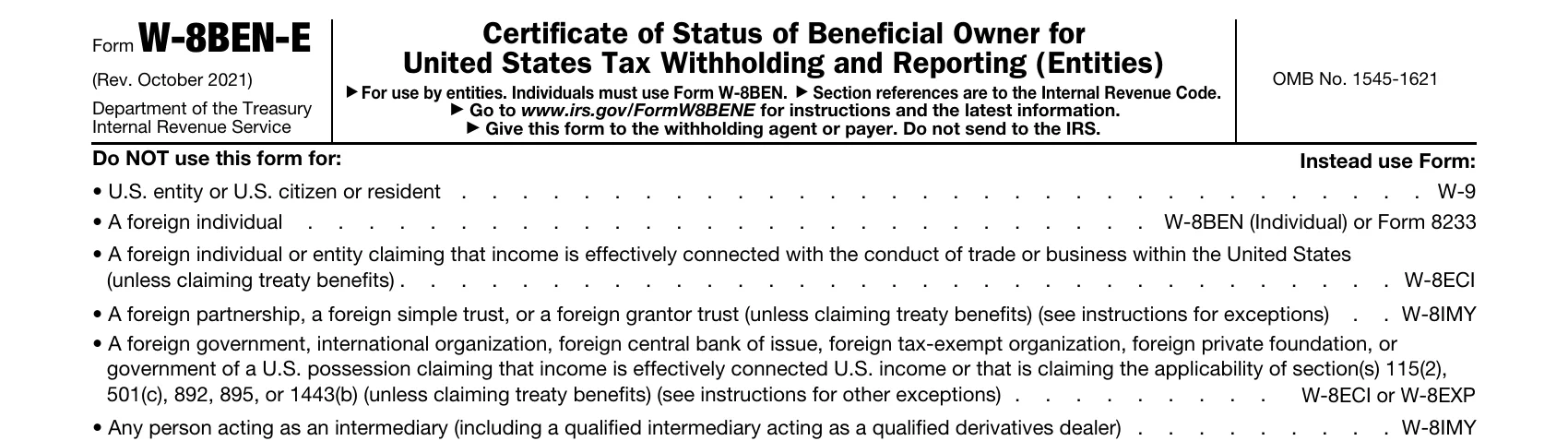
IRS Form W-8BEN-E (Rev. October 2021), top of page 1. Source: irs.gov.
- Revision date: October 2021 is the current version.
- For entities; individuals use Form W-8BEN.
- Give it to the payer (your company), not to the IRS.
- Who must not use this form: US persons (W-9), foreign individuals (W-8BEN) and others.
Part I, lines 1 to 4: the company and its classification
Line 1 is the company’s legal name and line 2 the country where it was incorporated or organized.[4] Line 3 is only for a disregarded entity receiving the payment in specific cases, so a company paid in its own name leaves it blank.[4] Line 4 asks for the chapter 3 status: check the one box that represents the company’s classification.[4]
For most Latin American companies that box is Corporation. US regulations list the Sociedad Anónima of Argentina, Brazil, Chile, Colombia, Mexico, Peru and Uruguay as per se corporations, and the Mexican entry includes a Sociedad Anónima de Capital Variable (S.A. de C.V.).[3] Companies that are not on that list, such as a Brazilian LTDA, a Colombian S.A.S. or an Argentine S.R.L., are classified by default as an association, that is, a corporation, when all their members have limited liability, unless the company has elected otherwise.[6]

Part I, lines 1 to 4. Source: IRS Form W-8BEN-E (Rev. October 2021).
- Line 1: the company's legal name.
- Line 2: country of incorporation, for example Mexico.
- Line 3: blank for a company paid in its own name.
- Line 4: chapter 3 status, one box only.
- Corporation: the usual box for an S.A., S.A. de C.V., LTDA, S.A.S. or S.R.L.
Line 5: the FATCA status, usually Active NFFE
Line 5 asks for the company’s chapter 4 (FATCA) status, and checking a box is a representation that the company qualifies for that status in its country of residence.[4] An operating company that sells services and is not a financial institution is normally an active NFFE, a non-financial foreign entity, as long as less than 50% of its gross income and less than 50% of its assets are passive.[2] Check Active NFFE. Complete Part XXV.
A company whose income is mostly passive, which the instructions describe as dividends, interest, rents, royalties, annuities and similar income, would check Passive NFFE and complete Part XXVI instead.[4]
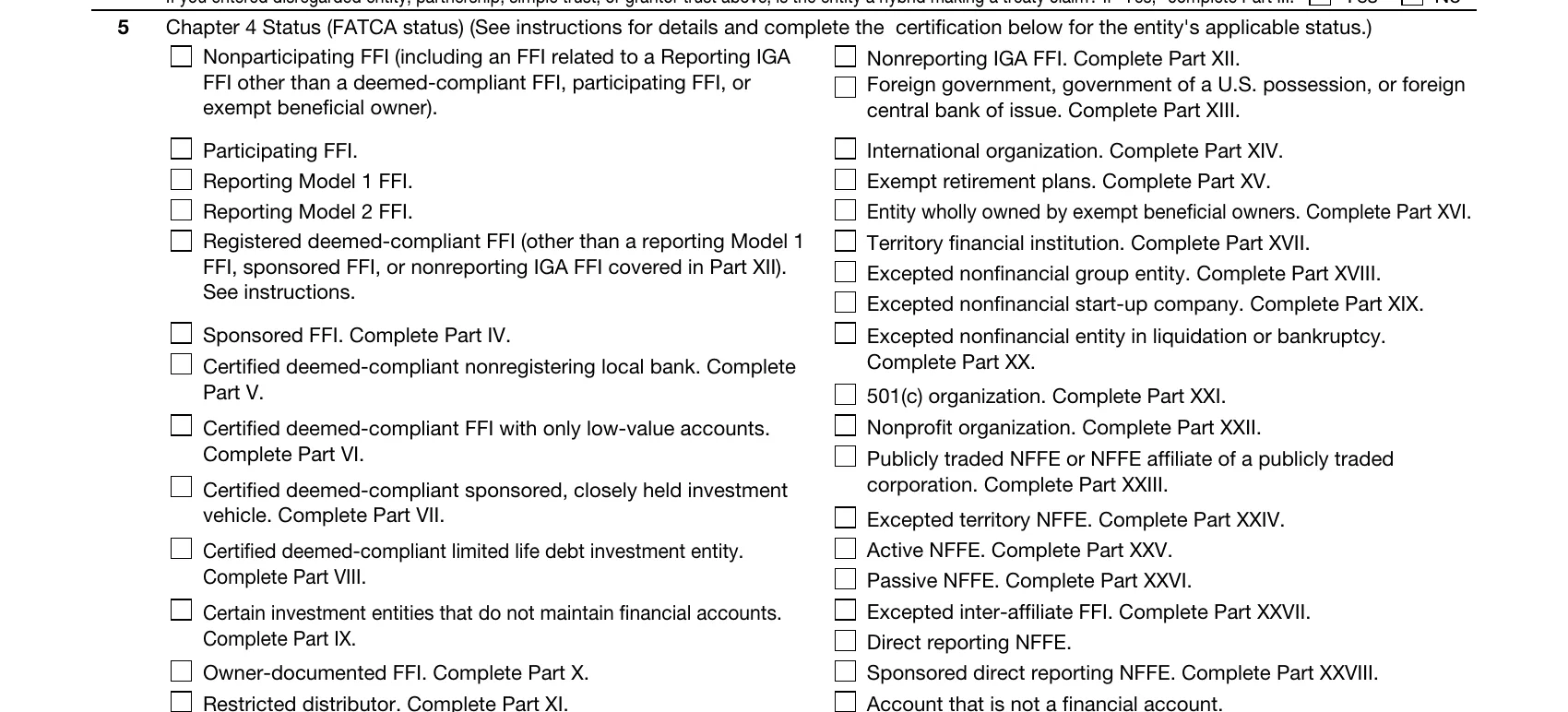
Part I, line 5. Source: IRS Form W-8BEN-E (Rev. October 2021).
- Line 5: chapter 4 (FATCA) status, one box only.
- Active NFFE: the usual box for an operating service company.
- Passive NFFE: only if passive income or assets reach 50%.
Lines 6 and 7: the company's address
Line 6 is the permanent residence address of the company named on line 1. It cannot be a financial institution’s address, a post office box or an address used only for mail,[4] although the form accepts a registered address.[2] Line 7 is a mailing address, only if it differs.
As with the individual form, a US address here is a reason to stop and ask: the IRS tells payers that a US permanent residence or mailing address on a Form W-8 can be a reason to know it is unreliable.[5]

Part I, lines 6 and 7. Source: IRS Form W-8BEN-E (Rev. October 2021).
- Line 6: the company's address. No P.O. box or bank address.
- Country of the address.
- Line 7: only if the mailing address is different.
Lines 8 to 10: tax ID numbers
Line 8 asks for a US employer identification number (EIN) only in the cases the instructions list, such as a treaty claim made without a foreign tax ID; a company paid for work done abroad leaves it blank.[4] Line 9a is the GIIN, which the instructions require from certain financial institutions and certain NFFEs; an operating company certifying active NFFE status has none to enter.[4] Line 9b is the foreign tax identifying number issued by the country where the company is a tax resident,[4] and line 10 is an optional reference.
| Country | Company tax ID for line 9b | Format |
|---|---|---|
| Mexico | RFC | 12 characters: 3 letters, 6 digits for the date of incorporation and a homoclave[7] |
| Colombia | NIT | 9 digits plus a check digit added by DIAN[8] |
| Brazil | CNPJ | 14 digits, formatted XX.XXX.XXX/XXXX-XX[9] |
| Argentina | CUIT | 11 digits starting with 30 or 33 for legal persons[10] |
| Chile | RUT | A serial number, a dash and a check digit from 0 to 9 or K[11] |
| Peru | RUC | 11 digits starting with 20 for legal entities[12] |

Part I, lines 8 to 10, at the top of page 2. Source: IRS Form W-8BEN-E (Rev. October 2021).
- Line 8: US EIN. Usually blank.
- Line 9a: GIIN. Blank for an active NFFE.
- Line 9b: the company's home-country tax ID.
- Line 10: optional reference, such as your vendor ID.
Part XXV: certify active NFFE status
Line 39 is a single checkbox, and checking it certifies three things: that the company is a foreign entity that is not a financial institution, that less than 50% of its gross income for the preceding calendar year was passive income, and that less than 50% of its assets produce or are held to produce passive income, measured as a quarterly weighted average.[2] The instructions describe passive income as dividends, interest, rents, royalties, annuities and certain other forms of income.[4] A company whose revenue is fees for the services its people perform usually meets both tests.

Part XXV, on page 7 of the form. Source: IRS Form W-8BEN-E (Rev. October 2021).
- Line 39: the one box to check.
- Not a financial institution.
- Passive income under 50% of last year's gross income.
- Passive assets under 50%, quarterly weighted average.
Part XXX: certification and signature
The form must be signed and dated by an authorized representative or officer of the company, and the signer must check the box certifying that they have the legal capacity to sign for it.[4] A withholding agent may accept an electronic signature, which must show that the form was signed electronically by a person authorized to do so.[4] By signing, the company also agrees to submit a new form within 30 days if any certification becomes incorrect.[2]
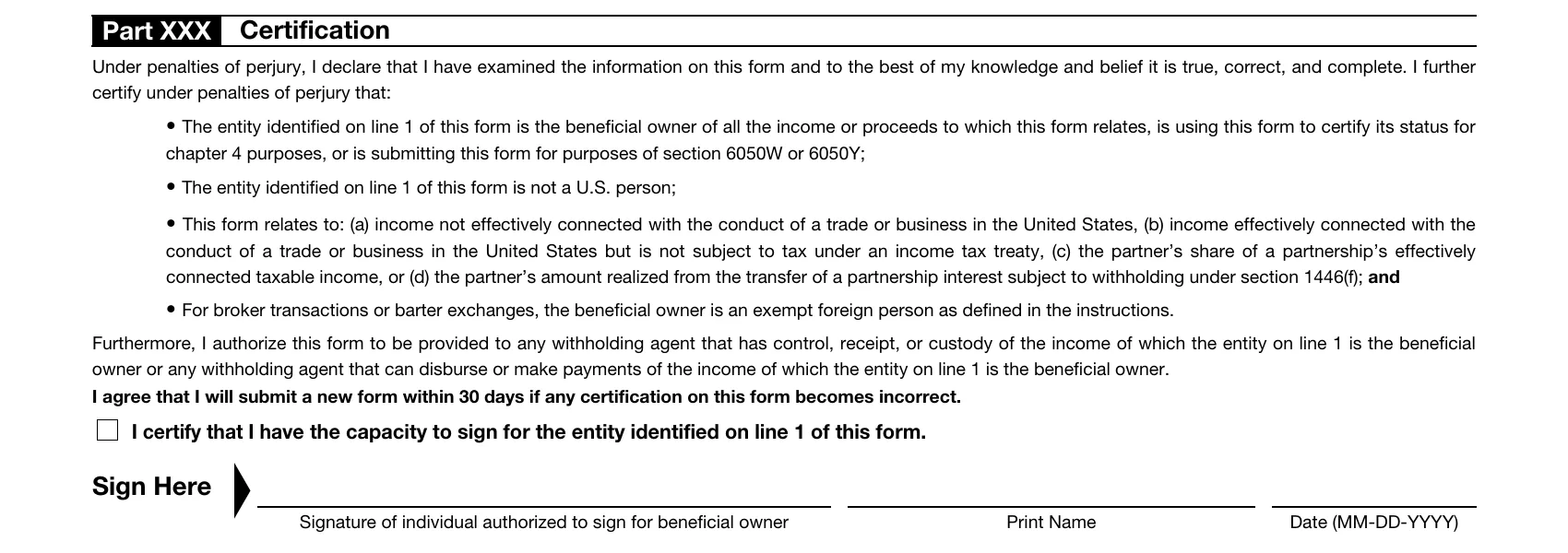
Part XXX, on page 8 of the form. Source: IRS Form W-8BEN-E (Rev. October 2021).
- The certification, signed under penalties of perjury.
- Includes that the entity on line 1 is not a US person.
- The company must send a new form within 30 days if anything changes.
- Capacity box: required for the person signing.
- Signature of the authorized representative or officer.
- Printed name.
- Date as MM-DD-YYYY.
Why does the contractor’s company need a W-8BEN-E?
For the same reason an individual contractor gives you a W-8BEN: it documents that the payee is a foreign person. IRS Publication 515 says that a foreign person who gives you a valid Form W-8 is exempt from backup withholding and Form 1099 reporting.[13] And because pay for services is sourced where the work is performed, a company whose people work in Latin America earns foreign-source income from you, outside US withholding.[14]
The only question is which W-8. If the contractor agreement and the invoices are in the company’s name, the company is the payee and the form is the W-8BEN-E. If the person invoices under their own name and tax ID, even with a business registration, use the W-8BEN for individuals instead.
Which parts does a small service company leave blank?
Almost all of them. The W-8BEN-E has thirty parts because it serves banks, funds, governments and charities as well as ordinary companies; an operating company that sells services and certifies as an active NFFE completes Part I, Part XXV and Part XXX.[2]
| Part | Title on the form | For a small service company |
|---|---|---|
| I | Identification of Beneficial Owner | Complete (lines 1 to 10) |
| II | Disregarded Entity or Branch Receiving Payment | Leave blank in the usual case |
| III | Claim of Tax Treaty Benefits | Leave blank for work done outside the US |
| IV to XXIV | Financial institution, government, plan and nonprofit statuses | Leave blank |
| XXV | Active NFFE | Complete (line 39) |
| XXVI | Passive NFFE | Only if the company is passive instead of active |
| XXVII to XXIX | Inter-affiliate FFI, sponsored direct reporting NFFE, substantial US owners | Leave blank |
| XXX | Certification | Complete and sign |
Part III stays blank for the same reason as on the individual form: a treaty only reduces US withholding on US-source income, and pay for work done outside the United States is not US-source.[14]
How long is a W-8BEN-E valid?
Until December 31 of the third calendar year after the year it was signed, unless a change in circumstances makes it incorrect first.[5] In the certification, the company agrees to submit a new form within 30 days if any certification becomes incorrect.[2] A form signed in 2026 is valid through December 31, 2029; note the date in your vendor records.
What if the contractor is a one-person company?
The form follows the legal entity, not the headcount. A one-person company that issues the invoices is still an entity and uses the W-8BEN-E; for US purposes, a foreign eligible entity whose single owner has limited liability is classified as an association, which is why it checks Corporation on line 4 unless it has elected otherwise.[6] A person who works under their own name and tax ID is an individual, and the right form is the W-8BEN.[2]
How do you hire in Latin America with Nearshorers?
Tell us the role on a 15-minute call and we turn it into a scorecard; most roles are filled in 7 to 14 days. Then choose one of our two hiring models. With Staffing, Nearshorers engages and pays the specialist, handles contracts, compliance and payments, and takes on the risk of the relationship, while you direct the work. With Headhunting, you hire them directly for a single placement fee, and the rules on this page apply to your company.
- 01/The briefA 15-minute call: the role, the metrics it should own and your budget, turned into a scorecard.
- 02/The shortlistWe search our Latin America network and vet for skill, English and ownership.
- 03/The interviewsYou interview the shortlist; we handle scheduling and feedback.
- 04/The onboardingHire through us with Staffing, where we take on the contract, payments and risk, or directly for a one-time fee.
Frequently asked questions
Does a Mexican S.A. de C.V. check Corporation on line 4?
Yes, in the usual case. US regulations list Mexico's Sociedad Anónima as a per se corporation and state that the term includes a Sociedad Anónima that applies the variable capital rules, the S.A. de C.V. Line 4 asks for one box only, and Corporation is the one that matches that classification.
Does my contractor's company need a GIIN?
Not if it is an ordinary operating company certifying active NFFE status. The instructions require a GIIN on line 9a from certain financial institutions and certain NFFEs, such as those that report directly to the IRS. A services company that is not a financial institution leaves line 9a blank and enters its home-country tax ID on line 9b.
Who signs the W-8BEN-E for the company?
An authorized representative or officer of the company, who must also check the box certifying their legal capacity to sign for it. The form can be signed electronically if you, as the withholding agent, allow it, and the electronic signature must show that a person authorized to sign did so. A typed name alone is not enough.
Do we complete Part III, the treaty claim?
Not for work done outside the United States. A treaty only reduces US withholding on US-source income, and pay for services is sourced where the work is performed. A Latin American company whose people work from Latin America earns foreign-source income from you, so there is no withholding to reduce and Part III stays blank.
How long is the W-8BEN-E valid?
Until December 31 of the third calendar year after the year it was signed, unless something on it becomes incorrect first; a form signed in 2026 is valid through December 31, 2029. The company agrees in the certification to send a new form within 30 days of any change that makes a certification incorrect.
Sources
Every figure on this page links to the source below that states it. Rules are cited from the statute or the agency that applies it, and every source was checked on November 2, 2026. This page is general information to plan a hire, not legal or tax advice; laws change, so confirm your case with a local lawyer or accountant.
- About Form W-8 BEN-E, Certificate of Status of Beneficial Owner for United States Tax Withholding and Reporting (Entities) Government · Internal Revenue Service · 2026-10-25 · checked November 2, 2026
- Form W-8BEN-E (Rev. October 2021) Government · Internal Revenue Service · 2021-10 · checked November 2, 2026
- 26 CFR § 301.7701-2, Business entities; definitions (per se corporations, paragraph (b)(8)) Law · Legal Information Institute, Cornell Law School · checked November 2, 2026
- Instructions for Form W-8BEN-E (Rev. October 2021) Government · Internal Revenue Service · 2021-10 · checked November 2, 2026
- Instructions for the Requester of Forms W-8BEN, W-8BEN-E, W-8ECI, W-8EXP, and W-8IMY (Rev. June 2022) Government · Internal Revenue Service · 2022-06 · checked November 2, 2026
- 26 CFR § 301.7701-3, Classification of certain business entities (default classification, paragraph (b)(2)) Law · Legal Information Institute, Cornell Law School · checked November 2, 2026
- Mexico: Information on Tax Identification Numbers Government · OECD · checked November 2, 2026
- Colombia: Information on Tax Identification Numbers Government · OECD · checked November 2, 2026
- Brazil: Information on Tax Identification Numbers Government · OECD · checked November 2, 2026
- Argentina: Information on Tax Identification Numbers Government · OECD · checked November 2, 2026
- Chile: Information on Tax Identification Numbers Government · OECD · checked November 2, 2026
- Peru: Information on Tax Identification Numbers Government · OECD · checked November 2, 2026
- Publication 515 (2026), Withholding of Tax on Nonresident Aliens and Foreign Entities Government · Internal Revenue Service · 2026 · checked November 2, 2026
- Source of income: personal service income Government · Internal Revenue Service · 2026-02-06 · checked November 2, 2026