How to fill out Form W-8BEN for a contractor in Latin America, line by line
A contractor who lives and works in Latin America fills out IRS Form W-8BEN and gives it to your company; nobody sends it to the IRS. It documents that they are a foreign person, so you file no Form 1099-NEC. Pay for work done outside the US is not US-source income, so there is no US withholding and no Form 1042-S. Line 6a takes their home-country tax ID, and Part II usually stays blank.

At a glance
- Form and revision
- W-8BEN, Rev. October 2021, the current version[1]
- Who fills it out
- The contractor, as an individual. A company uses Form W-8BEN-E[2]
- Who keeps it
- You, the US payer. It is never sent to the IRS[3]
- Valid until
- December 31 of the third year after signing: a form signed in 2026 is valid through 2029[4]
- US tax on work done abroad
- None. Pay for services performed outside the US is foreign-source income[5]
- Form 1099-NEC
- Not filed for a foreign person who gave you a valid Form W-8[6]
Check that the W-8BEN is the right form
Download the form from irs.gov: the current version is the October 2021 revision, and the IRS lists no newer one.[1] The header tells the contractor to give the form to the payer and not to send it to the IRS,[2] and the box under it lists the cases where the W-8BEN is the wrong form. Check them before you send it:
| If your contractor… | Use instead | Why |
|---|---|---|
| Invoices through a company (S.A. de C.V., S.A.S., LTDA, S.R.L.) | Form W-8BEN-E | Foreign entities document their status on Form W-8BEN-E[7] |
| Is a US citizen or other US person living in Latin America | Form W-9 | US persons document their status on Form W-9[3] |
| Does the work while in the United States | Form 8233 or Form W-4 | The form excludes pay for personal services performed in the US[2] |
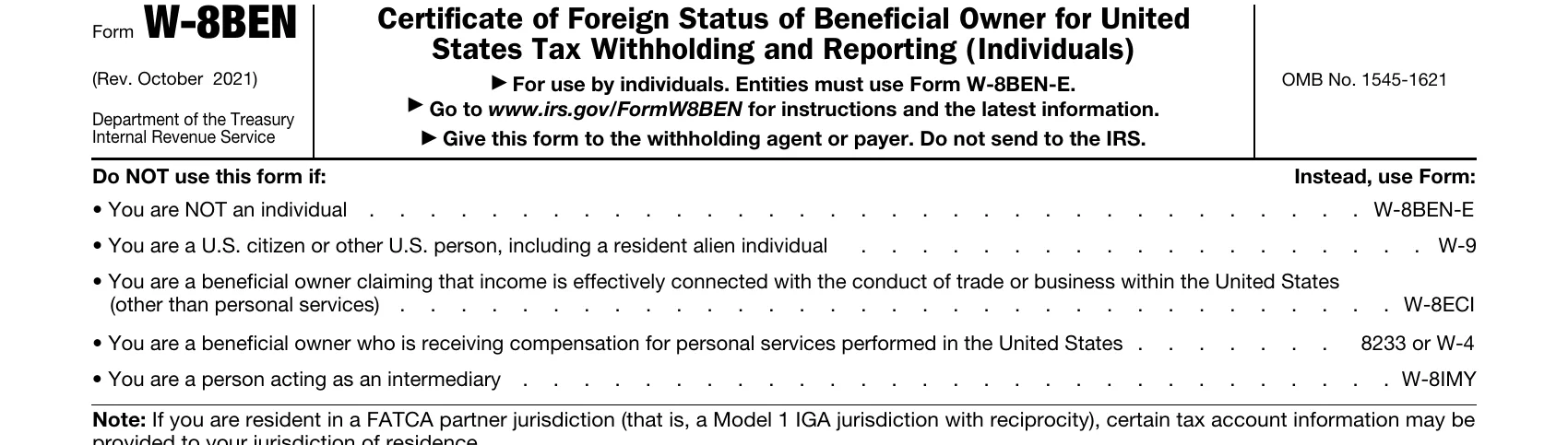
IRS Form W-8BEN (Rev. October 2021), top of page 1. Source: irs.gov.
- Revision date: October 2021 is the current version.
- Give the form to the payer (your company), not to the IRS.
- The cases where this is the wrong form: a company (W-8BEN-E), a US person (W-9) or pay for work done in the US (Form 8233 or W-4).
Part I, lines 1 to 4: name, citizenship and addresses
Lines 1 to 4 identify the contractor as an individual. Ask them to use the same name and address that appear on their tax registration at home, because that is the identity the tax ID on line 6a belongs to.
- Line 1: the contractor’s name.[3]
- Line 2: their country of citizenship.[3]
- Line 3: their permanent residence address, with street, city, postal code and country. It cannot be a financial institution’s address, a P.O. box or an address used only for mail.[3]
- Line 4: a mailing address, only if it differs from line 3.[3]
A US address on line 3 or line 4 is the mistake to catch here. The IRS tells payers that a current US permanent or mailing address on a Form W-8 can be a reason to know the form is unreliable, so ask the contractor about it before you accept the form.[4]
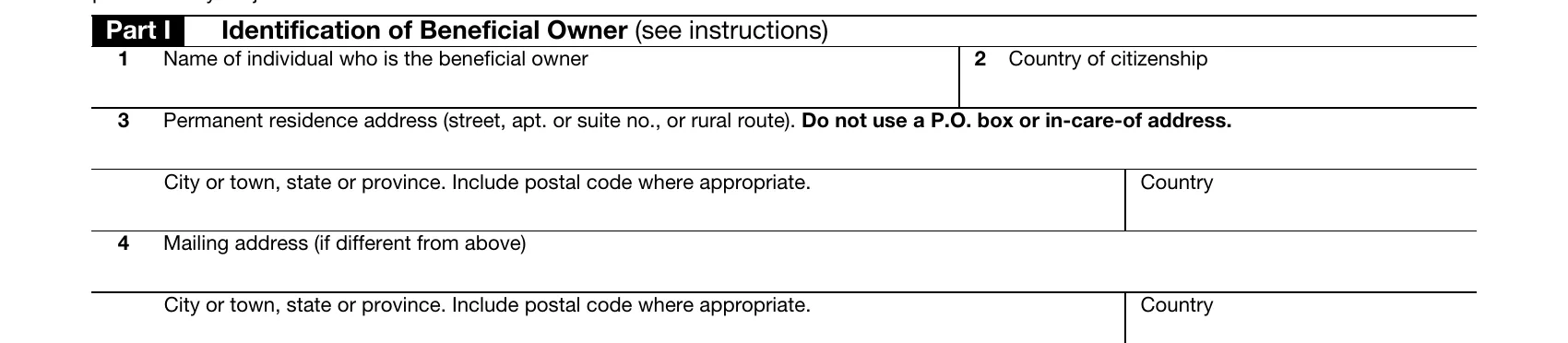
Part I, lines 1 to 4. Source: IRS Form W-8BEN (Rev. October 2021).
- Line 1: the contractor's name.
- Line 2: country of citizenship.
- Line 3: permanent residence address. No P.O. box and no bank address.
- Country of the line 3 address, for example Mexico.
- Line 4: only if the mailing address is different.
Lines 5 to 8: tax ID numbers and date of birth
Line 5 asks for a US taxpayer identification number (an SSN or ITIN) only in the cases the instructions list; a contractor paid for work done in Latin America normally leaves it blank.[3] Line 6a is the one that matters: the foreign tax identifying number (FTIN) issued by the country where the contractor is a tax resident.[3] Line 6b is checked only if the contractor is not legally required to obtain an FTIN. Line 7 is an optional reference number that either of you can use, such as your vendor ID, and line 8 is the date of birth in MM-DD-YYYY format.[3]
What goes on line 6a, country by country:
| Country | Tax ID for line 6a | Format for individuals | Issued by |
|---|---|---|---|
| Mexico | RFC (Registro Federal de Contribuyentes) | 13 characters: 4 letters, 6 digits from the date of birth and a 3-character homoclave[8] | SAT |
| Colombia | NIT (Número de Identificación Tributaria) | For a citizen, the cédula number; DIAN adds a separate check digit[9] | DIAN |
| Brazil | CPF (Cadastro de Pessoas Físicas) | 11 digits, the last 2 being check digits[10] | Receita Federal |
| Argentina | CUIT (Clave Única de Identificación Tributaria) | 11 digits: prefix 20, 23, 24 or 27, the 8-digit DNI and a check digit[11] | ARCA, formerly AFIP[12] |
| Chile | RUT (Rol Único Tributario) | A serial number, a dash and a check digit from 0 to 9 or K[13] | SII |
| Peru | RUC (Registro Único de Contribuyentes) | 11 digits: prefix 10, the DNI and a check digit[14] | SUNAT |
Before you accept the form, compare the number on line 6a with the one on the contractor’s invoices or tax registration certificate.

Part I, lines 5 to 8. Source: IRS Form W-8BEN (Rev. October 2021).
- Line 5: US tax ID. Usually blank for work done abroad.
- Line 6a: the home-country tax ID (RFC, NIT, CPF, CUIT, RUT or RUC).
- Line 6b: check only if the contractor is not legally required to have a tax ID.
- Line 7: optional reference, such as your vendor ID.
- Line 8: date of birth as MM-DD-YYYY.
Part II: leave the treaty claim blank unless the work happens in the US
Part II is where a resident of a treaty country claims a reduced rate of US withholding.[3] A contractor paid for work done in Latin America has no US-source income from you, because personal service income is sourced where the work is performed.[5] With no US-source income there is no withholding to reduce, so Part II stays blank.
Part II only comes into play when the person works while in the United States, and even then most of the region has no treaty to claim: the IRS list of income tax treaties includes Mexico, Chile and Venezuela, but not Argentina, Brazil, Colombia, Costa Rica, Peru or Uruguay.[15] For pay for personal services performed in the US, the form itself points to Form 8233 or Form W-4 instead.[2]

Part II, claim of tax treaty benefits. Source: IRS Form W-8BEN (Rev. October 2021).
- Line 9: treaty country. Blank for work done in Latin America.
- Line 10: special rates and conditions. Blank in the same case.
Part III: signature, date and printed name
The contractor signs under penalties of perjury, certifying among other things that the person on line 1 is not a US person, and agrees to submit a new form within 30 days if any certification becomes incorrect.[2] The form must be signed and dated by the beneficial owner, the person named on line 1; the capacity checkbox is only for someone who signs on their behalf.[3]
Electronic signatures are allowed, but typing a name on the signature line is not an electronic signature.[3] You may accept an electronic signature that meets the IRS requirements, such as the signer’s name with a time and date stamp and a statement that the form was signed electronically, and you may rely on a signed form received as a scan by email unless you know the sender was not authorized to send it.[4]
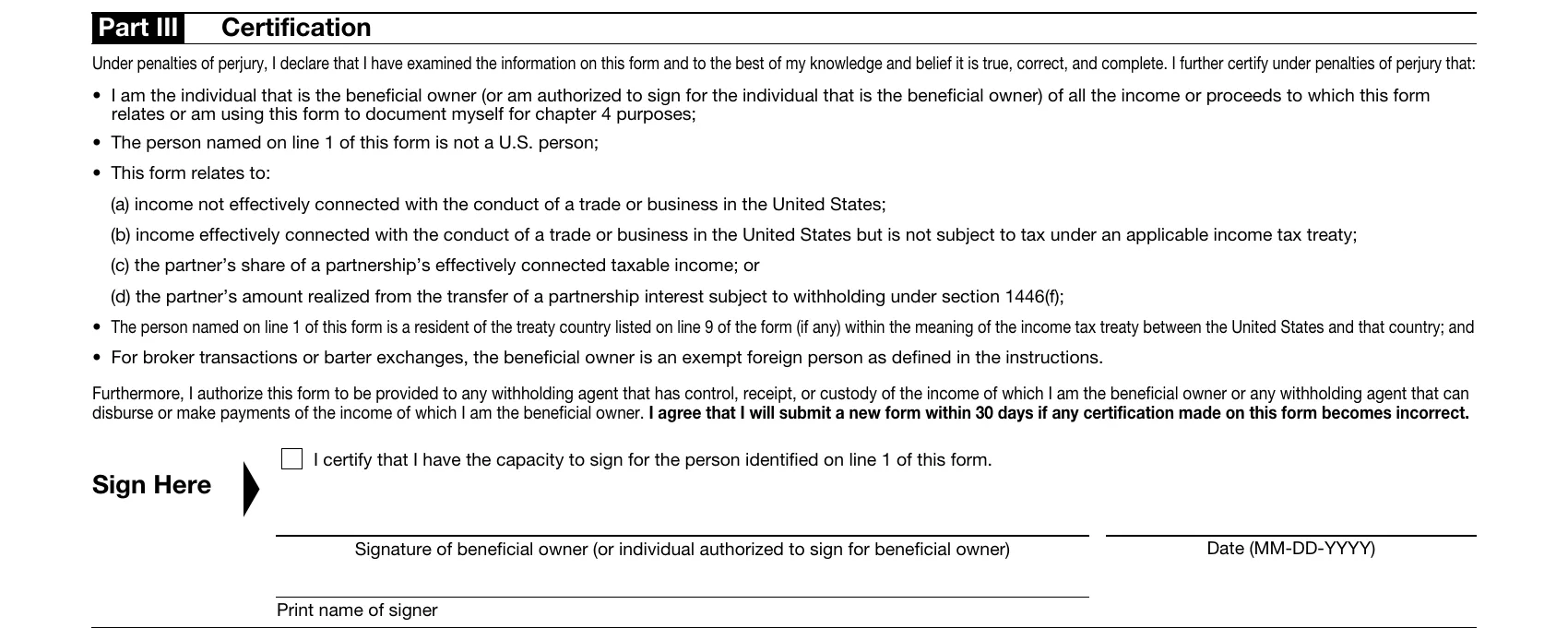
Part III, certification. Source: IRS Form W-8BEN (Rev. October 2021).
- The certification the contractor signs under penalties of perjury.
- It includes that the person on line 1 is not a US person.
- Capacity box: only if someone else signs for the contractor.
- The contractor's signature.
- Date as MM-DD-YYYY.
- Printed name of the person who signs.
Why does a US company need a W-8BEN from a contractor in Latin America?
Because it is the document that lets you treat the contractor as a foreign person. IRS Publication 515 says that a foreign person who gives you a valid Form W-8 is exempt from backup withholding and Form 1099 reporting.[6] Without documentation, you have to decide the payee’s status with the IRS presumption rules,[6] and if they point to a US payee, the payment falls under Form 1099-NEC reporting and backup withholding at 24%.[16]
The form does not create a tax. Pay for personal services is sourced where the work is performed, regardless of where the contract was signed or where the payment comes from,[5] and the IRS states that wages earned by nonresident aliens for services performed outside the United States are not subject to US income tax withholding or reporting.[17] The W-8BEN is the paper trail that shows why you withheld nothing and filed nothing.
Do you file a Form 1099-NEC or a Form 1042-S for a contractor in Latin America?
No, in the usual case: a contractor who lives in Latin America, works from there and gave you a valid W-8BEN. Form 1099-NEC is for US payees, and from tax year 2026 it applies to nonemployee compensation of $2,000 or more.[18] For nonresident aliens, the same instructions send payers to Form 1042-S,[18] which covers US-source income subject to withholding. Pay for work done in Latin America is not US-source,[5] so it does not go on either form.
The answer changes when the work happens on US soil. Payers generally withhold 30% on compensation paid to a nonresident alien for personal services performed in the United States, unless that pay is specifically exempted,[19] and pay for work done partly in the US and partly abroad is split on a time basis.[5]
| Contractor’s situation | Form to collect | US information return |
|---|---|---|
| Lives and works in Latin America, invoices as an individual | W-8BEN | None |
| Lives and works in Latin America, invoices through a company | W-8BEN-E | None |
| Performs part of the work while in the United States | Form 8233 or Form W-4 for the US work | Form 1042-S for the US-source part |
| Is a US citizen or other US person living in Latin America | Form W-9 | Form 1099-NEC at $2,000 or more a year |
How long is a W-8BEN valid?
Until December 31 of the third calendar year after the year it was signed, unless the contractor’s circumstances change first.[4] If something on the form becomes incorrect, for example because the contractor moves to another country, they must notify you within 30 days.[3]
| Signed in | Valid through |
|---|---|
| 2025 | December 31, 2028 |
| 2026 | December 31, 2029 |
| 2027 | December 31, 2030 |
Record the expiry date with the contractor’s vendor details and ask for a new form a month before it. The IRS tells payers to keep Forms W-8 for as long as they may be relevant to their tax liability, and not to send them to the IRS.[4]
What are the most common W-8BEN mistakes?
Check these eight points before you file the form away:
- The wrong form for the payee. A contractor who invoices through a company needs Form W-8BEN-E, the form for foreign entities.[7]
- A US address on line 3 or line 4 that nobody has explained.[4]
- A P.O. box or a bank’s address as the permanent residence on line 3.[3]
- Line 6a left blank without line 6b checked: the foreign tax ID is required unless an exception applies.[3]
- The date of birth in the wrong order. Line 8 uses MM-DD-YYYY, so March 4, 1990 is 03-04-1990.[3]
- A typed name instead of a signature. Typing a name on the signature line is not an electronic signature.[3]
- Part II filled in for work done outside the US, where there is no US-source income for a treaty rate to apply to.[5]
- An old version of the form. The current one reads Rev. October 2021 in the top-left corner.[1]
Does the W-8BEN replace a contractor agreement?
No. The W-8BEN only certifies who the payee is for US tax purposes: their foreign status and, if they claim one, their treaty country.[2] It says nothing about the scope of work, payment terms, confidentiality or who owns what the contractor creates. Those terms belong in a written contractor agreement, and whether the relationship is really independent is decided by the labor law of the country where the contractor works, not by any US form.
How do you hire in Latin America with Nearshorers?
Tell us the role on a 15-minute call and we turn it into a scorecard; most roles are filled in 7 to 14 days. Then choose one of our two hiring models. With Staffing, Nearshorers engages and pays the specialist, handles contracts, compliance and payments, and takes on the risk of the relationship, while you direct the work. With Headhunting, you hire them directly for a single placement fee, and the rules on this page apply to your company.
- 01/The briefA 15-minute call: the role, the metrics it should own and your budget, turned into a scorecard.
- 02/The shortlistWe search our Latin America network and vet for skill, English and ownership.
- 03/The interviewsYou interview the shortlist; we handle scheduling and feedback.
- 04/The onboardingHire through us with Staffing, where we take on the contract, payments and risk, or directly for a one-time fee.
Frequently asked questions
Does a contractor in Mexico need a US tax ID to fill out Form W-8BEN?
No, not to be paid for work done in Mexico. Line 5 asks for a US taxpayer identification number only in the cases the instructions list, and a contractor working from Mexico gives their Mexican RFC on line 6a instead. For an individual, the RFC has 13 characters: four letters, six digits from the date of birth and a three-character homoclave.
Do I need to send the W-8BEN to the IRS?
No. The contractor gives the form to you, the payer, and you keep it in your records for as long as it may be relevant to your US tax obligations. The IRS instructions say explicitly not to send Form W-8BEN to the IRS. Store it with the contractor agreement and invoices, and note the date it expires.
Can my contractor sign the W-8BEN electronically?
Yes, if the electronic signature meets IRS requirements, such as the signer's name with a time and date stamp and a statement that the form was signed electronically. Typing a name on the signature line is not enough on its own. A signed form scanned and sent by email is also acceptable, unless you know the sender was not authorized to send it.
What if my contractor works from the United States for a few weeks?
Pay for the days worked in the US is US-source income, because personal service income is sourced where the work is done, and work split between countries is allocated on a time basis. That part is generally subject to 30% withholding unless an exemption applies, and the W-8BEN itself points to Form 8233 or Form W-4 for services performed in the US.
How often does a contractor need to renew the W-8BEN?
Roughly every three to four years. The form stays valid until December 31 of the third calendar year after the year it was signed, so a form signed in 2026 is valid through December 31, 2029. The contractor has to send a new one within 30 days if something on it becomes incorrect, for example after moving to another country.
Sources
Every figure on this page links to the source below that states it. Rules are cited from the statute or the agency that applies it, and every source was checked on November 2, 2026. This page is general information to plan a hire, not legal or tax advice; laws change, so confirm your case with a local lawyer or accountant.
- About Form W-8 BEN, Certificate of Foreign Status of Beneficial Owner for United States Tax Withholding and Reporting (Individuals) Government · Internal Revenue Service · 2026-10-02 · checked November 2, 2026
- Form W-8BEN (Rev. October 2021) Government · Internal Revenue Service · 2021-10 · checked November 2, 2026
- Instructions for Form W-8BEN (Rev. October 2021) Government · Internal Revenue Service · 2021-10 · checked November 2, 2026
- Instructions for the Requester of Forms W-8BEN, W-8BEN-E, W-8ECI, W-8EXP, and W-8IMY (Rev. June 2022) Government · Internal Revenue Service · 2022-06 · checked November 2, 2026
- Source of income: personal service income Government · Internal Revenue Service · 2026-02-06 · checked November 2, 2026
- Publication 515 (2026), Withholding of Tax on Nonresident Aliens and Foreign Entities Government · Internal Revenue Service · 2026 · checked November 2, 2026
- About Form W-8 BEN-E, Certificate of Status of Beneficial Owner for United States Tax Withholding and Reporting (Entities) Government · Internal Revenue Service · 2026-10-25 · checked November 2, 2026
- Mexico: Information on Tax Identification Numbers Government · OECD · checked November 2, 2026
- Colombia: Information on Tax Identification Numbers Government · OECD · checked November 2, 2026
- Brazil: Information on Tax Identification Numbers Government · OECD · checked November 2, 2026
- Argentina: Information on Tax Identification Numbers Government · OECD · checked November 2, 2026
- Decreto 953/2024: disolución de la AFIP y creación de la Agencia de Recaudación y Control Aduanero (ARCA) Law · Boletín Oficial de la República Argentina · 2024-10-25 · checked November 2, 2026
- Chile: Information on Tax Identification Numbers Government · OECD · checked November 2, 2026
- Peru: Information on Tax Identification Numbers Government · OECD · checked November 2, 2026
- United States income tax treaties: A to Z Government · Internal Revenue Service · 2026-01-03 · checked November 2, 2026
- Backup withholding Government · Internal Revenue Service · 2026-10-10 · checked November 2, 2026
- Persons employed abroad by a U.S. person Government · Internal Revenue Service · 2026-05-22 · checked November 2, 2026
- Instructions for Forms 1099-MISC and 1099-NEC Government · Internal Revenue Service · checked November 2, 2026
- Pay for personal services performed Government · Internal Revenue Service · 2026-08-18 · checked November 2, 2026